|
|
2 February morning 1945, Leutnant Erich Wittor was ordered to hand over his position to some SS grenadiers and to take the village of Trettin (Drzecin in Poland at present). They drove along the road along a low hill with necessary care. They found some Russian tanks in the village. They were unable to beat off Russian tanks without artillery support or anti-tank support. Suddenly, Oberst Rudel’s Ju 87 Stuka appeared again and ripped off the Russian tanks one by one. The squadron was further supported by a company of Panzergrenadier and they retook the village (1). The right flank of KG Langkeit was about to open. |
It happened here: Leutnant Erich Wittor's armor patrol squadron marched from Kunersdoft to Trettin.
|
2 February morning 1945, the first battalion of Panzergrenadier-Regiment under Major Petereit continued attack again to the northwest of the road into the forest position occupied by Russians. This time they succeeded in clearing the forest position and the right flank of the KG Langkeit was opened. The Jagdpanzer 38 Hezter of the Jagd Panzer Kompanie 1551 also moved forward and Major Hudel also attacked along the road. Finally at about 14:00 hours, the Russian gave up the blockade. The first vehicles in the head of the column began moving and followed by tanks toward Kunersdorf. Later there was another firefight with Russian tanks, in which Feldwebel Adam Riedmüller (2) knocked out 4 T-34s and reopened the road. When there was unfavorable terrain prevented him from reaching T-34s with his Jagdpanzer 38 Hezter, he climbed out of his tank and destroyed them with Panzerfaust. He was later decorated with the Knight’s Cross for this action on 8 February 1945 (3).
2 February afternoon 1945, between Kundersdorf and Trettin, the Russian 1st Guard Tank Brigade stopped and withdrew back not only due to lack of fuel (4) but also due to determined German counterattack from air (Oberst Rudel's Ju 87 Stuka), infantry (Leutnant Erich Wittor's armor patrol squadron and first battalion of Panzergrenadier-Regiment) and tanks (Jagdpanzer 38 Hezter of the Jagd Panzer Kompanie 1551) (5). The battle field was the very same ground where the Russians and the Austrians defeated Frederick the Great on 12 August 1759. This time the Russain 1st Guard Tank Brigade met the fiercest encounter with German KG Langkeit in the same battle field. |
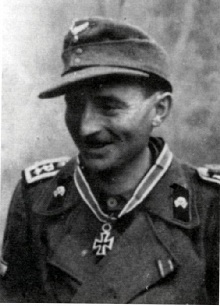
Feldwebel Adam Riedmüller |
2 February afternoon 1945, more and more vehicles passed through Kunersdorf, past the airfield and into the suburbs of Frankfurt/Oder. The second battalion of Panergreandier-Regiment initially occupied flanking positions in Kunersdorf. The artillery battalion also changed positions to the first houses of Frankfurt/Oder. The bulk of KG Langkeit initially stopped in the Dammvorstadt (Słubice in Poland at present), the eastern suburb of Frankfurt/Oder then moved to the west bank into barrack for rest and refit. Only the second battalion and infantry gun company of Panzergrenadier-Regiment and artillery battalion remained in the Dammvorstadt. They held the bridgehead until the night on 21-22 April and withdrew to west bank after they blew up the road bridge. |
It happened here: KG Langkeit fought back through Kunersdorf to Dammvorstadt and Frankfurt/Oder.
|
Reference:
1. Le Tissier, Tony. With Our Backs to Berlin, p3. Phoenix Mill: Sutton Publishing, 2001.
3. Spaeter, Helmuth. Panzerkorps Grossdeutschland, p220. West Chester: Schiffer Publishing, 1990.
4. Le Tissier, Tony. Zhukov at the Oder, p37. Westport, Connecticut, London: Praeger Publishing, 1996.
|
|
|